Farrier Tales

The posts you are about to read are a collection of experiences during my early years as a farrier. They begin with my weekly updates as a student at Farrier School and morph into vignettes from the road as I built up my business.
These letters tell the journey of how I turned my passion into my profession. I hope you enjoy reading the tales of this farrier. 


Angela at Horse Camp… I mean Farrier School

Written once upon a time… 

This is my first week of horse school, and I just finished day 4. The instruction includes observation, lecture, and practice, practice, practice. Rinse, & repeat.

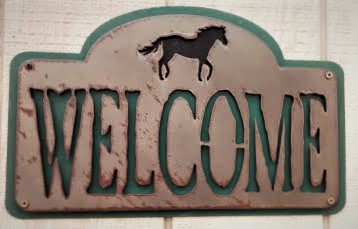
 welcome sign

The instructor is a third generation farrier and one of the nicest men I’ve ever met. His sport is Cowboy Mounted Shooting (shooting a gun at targets as you barrel race on top of a horse… could you get more republican?) His expertise is horsemanship, blacksmithing, and putting shoes on horses. Now in his sixties, he gets a lot of mileage by passing along his knowledge to the younger generations.
Mark Plumlee

My fellow students are all very kind. One is a rodeo prince who goes to a college in Wyoming that has horse-shoeing classes and roping competitions. He’s a talented hot-shot. Another is an ex-marine who grew up on a farm and took charge of the military’s mules in California. I guess the armed forces still uses equine transportation. Another guy served in the air force, and all he wants now is to live quietly in the country with horses. I’m the white-collar brunette who’s surpassing everyone’s expectations (although, that’s not saying much, since I’m sure they had very low expectations for a girl who doesn’t know horse knots).  The class assistant is a cute Canadian girl with a big truck and country accent. She gives me rides to and from the school. We’re also roommates. Two students from the last session have paid for a second term to have extra practice under a great instructor (and perhaps to avoid starting up their own clientele).  So there we are: 4 guys, 3 girls, and horse, after horse, after horse.

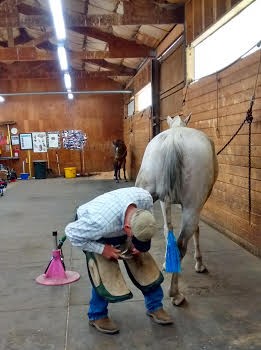
 In the mornings I’ve been getting practice “under the horses.” I strap on a huge pair of chaps, gather my tools, and then approach the horse. I’m learning to ask for the foot, and once I have it, struggle to keep it in my hand / lap. It’s hard to use new tools on a moving subject, especially one that looks over your shoulder and breathes down your neck. Some things I’ve made note of to myself: get some steel-toed shoes in case I get stepped on, and get a tetanus booster.

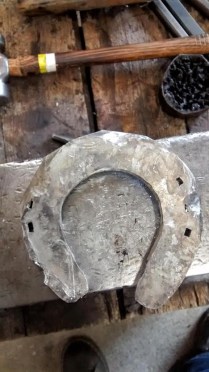
 In the afternoons, we take time on the anvil. The ANVIL!  One you would see in Loony Toons, or, I suppose, in Brawny Man’s garage. It involves forges and tongs and hammers. Our first task was to straighten a horseshoe completely. The following day, we were told to shape it back to its original shape. I’m slow, but eventually, I got good results!


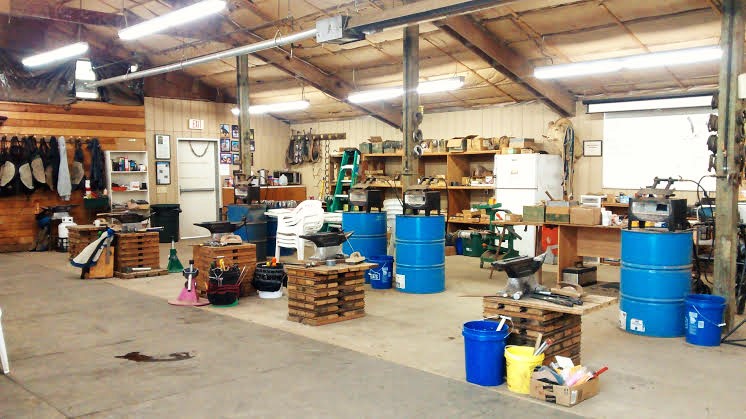
Here’s the classroom.

classroom

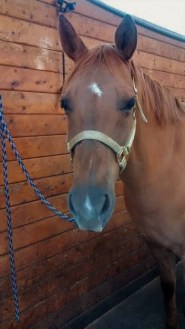
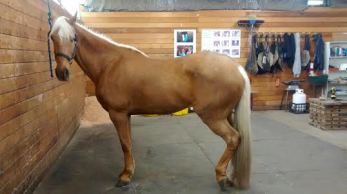
And the subject / patient / very heavy animal

horse

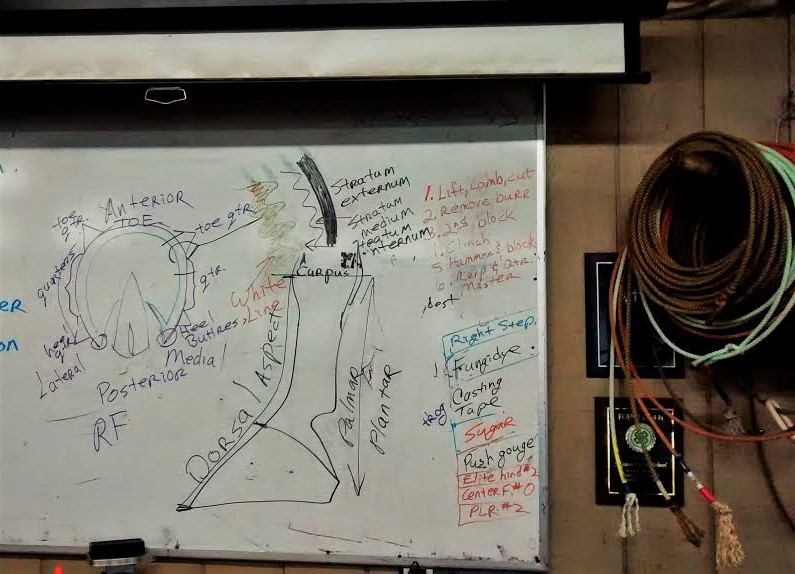
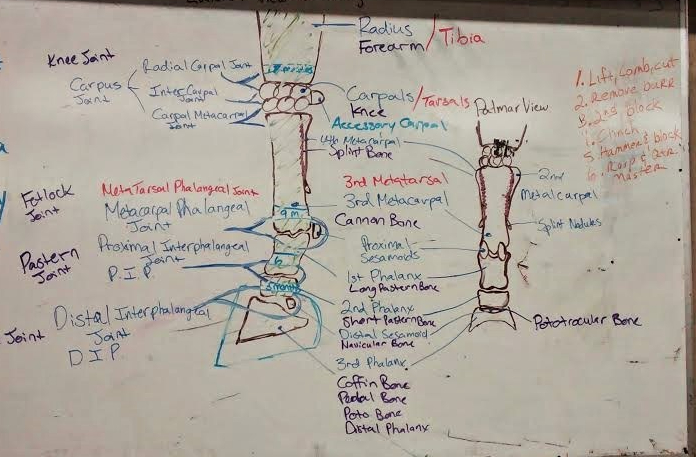
Hoof Vocabulary

white board

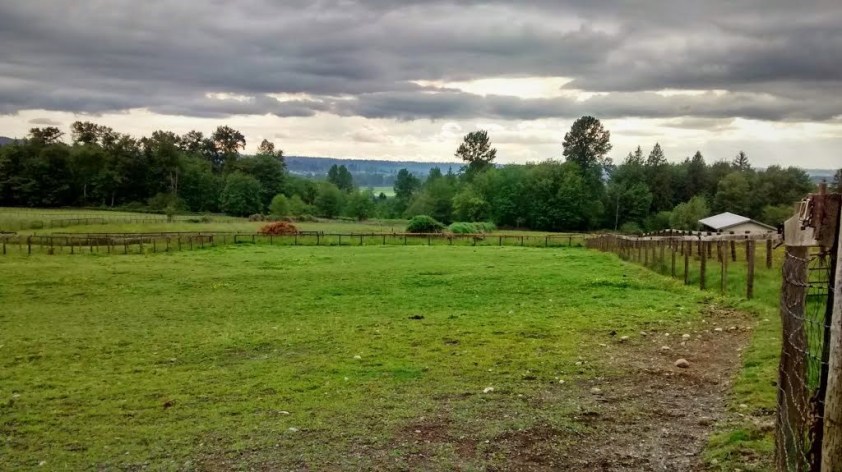
The school’s property

property

I’m having a lot of fun, learning LOTS, and trying to keep my nails clean. I’m living in a little apartment during the week (boarding is included in the tuition) and I’m looking forward to taking a break this weekend and returning home for a few days.

I am pinching myself to make sure I’m not dreaming. 

Dirty nails,

Angela

Angela at Farrier School, week 2

Someone at church this weekend asked me why horses need shoes. What a great question!!  Let me practice explaining.

Humans have domesticated horses. This means we have taken them out of their natural environment and brought them home to live with us. They are designed to live in herds and run around on hard terrain, ground that trims their hoofs on a daily basis. Put them in Western Washington (or Florida, or Kentucky), and they spend a lot of time in a wet environment, whether it’s in the mud or in a dirty stall. Moist hoofs are like wet fingernails: soft and weak. Shoes lift the horses up off the ground a bit, helping the hoof to keep dry. Additionally, shoes can protect a horse during various activities: ground is too rocky?  Put on a steel shoe!  You need more traction in a sandy performance ring?  Put on a swift aluminum shoe!  Your horse is lame? Put on some Stryofoam and duct tape and let the pony rest!

Or, you could just call the Farrier to trim the hoofs every 8 weeks. That’s common too. This week, for example, we took a field trip to a stables full of Arabian horses. Twenty-eight, to be exact. These horses are entered in all sorts of beauty pageants, which is why they can get away with names like Lady, Angel, and Princess.

 Barbie horse

I think Barbie is missing her horse.


And then we get clients like Dolly, a pony for sale on the side of the road. She was found by a family who drove by, saw her tethered up, and bought her on the spot. She’s been a member of the family for 9 years, and arrived at the school in the back of a suburban for her trim:


School starts at 9am each day, and usually by 9:30 the horses have arrived and we each share the work of shoeing them. Today, me and Kevin (the rookies) were given a hind hoof each. Pulling off a shoe should take < 2 minutes. My shoe took 20 minutes. Between the horse’s jerky foot movements and my clumsy use of the tools, I had beads of sweat running down my face before 10 am. But don’t worry, I won 🙂  By lunch time I had taken off a shoe, trimmed the hoof wall, rasped the heels, drawn my lines and shaped a brand new shoe for “Missy.” She had only crushed my fingers twice and landed on top of my foot once. When it came time to “set” the shoe, I got a handful of special horseshoeing nails and got ready to drive the first nail. 

Tangent: The White Line is where you drive the nails. If you go inside of the white line, you’re in sensitive area, and it will hurt the horse. If you go outside of the white line, your nail won’t have enough hoof wall to hang onto, and the shoe will fall off. Unfortunately, the real hoofs don’t resemble the diagrams very closely, and the white line isn’t even white.


Back to the story: I drove my first nail to set the shoe, right where it belongs!  2nd nail, bam! Third nail, took a few tries, but then it finally went in. I took a break to straighten up my back and give the horse a break, when Kevin exclaimed, “Are you okay?!”  “Yeah, why?”  “There’s blood on the floor!”  My third nail had gone into the soul of the hoof, and Missy was, indeed, bleeding. The assistant came right over, filled the puncture with “hot nail solution,” and then said my shoe was on crooked, which is why my nail got in the wrong place. I felt terrible: the hoof medicine had a pungent smell and stung my eyes a bit; my hand was in a lot of pain from when the horse had stepped on it, and I was so bad at it all that I had to excuse myself to cry out my stress in the dingy barn bathroom. I didn’t know whether I felt sorry for myself or sorry for the horse. Actually, I know I felt sorry for the both of us.

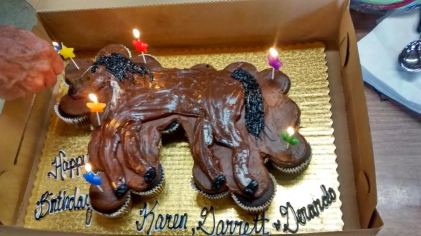
Bright spot in the day: we celebrated three birthdays with a horse cake!

horse cake

 
Rest assured: I am not gravely injured. Just scratches and bruises for the most part. 
 
Sore but happy,
Angela

Angela at Farrier School, week 3

Prepare yourself for a full email of hoof notes. I’ve included lots of pictures, stories, and fun facts for your enjoyment.
Firstly, why do they call ’em Farriers?  Along with 60% of all the other English words, Farrier comes from a French word! Ferrier means Blacksmith. The Latin root, ferrum, means iron. Historically, a Farrier would not only make horse shoes, but all sorts of pre-industrial revolution tools. (compliments to Wikipedia).

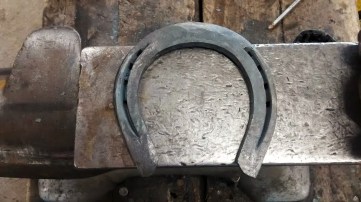
About a third of our time in school is spent at the anvil. Since each hoof needs a well-fitting shoe, the farrier will adjust a front shoe or a hind shoe ordered from the manufacturer. A front shoe is rounder, and wider at the middle. A hind shoe is narrower at the toe and wider at the lower 1/3. Generally. See if you can tell which is which in the photo below!
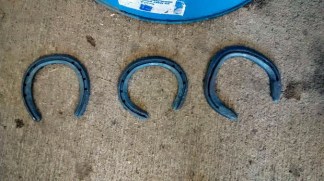
shoes

But then we make adjustments for laminitic hoofs, clubbed hoofs, compromised hoof walls, sensitive souls, etc, etc.  If only we customize women’s jeans like this!

Here are a few pictures of me forging a shoe from scratch:

Measure the stock, mark the center and the toe quarters, then heat thoroughly.
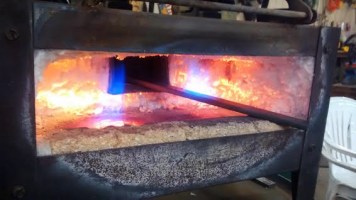
bar stock in forge

Don’t touch the steel with your hands. Use fire tongs.  And safety goggles.

use tongs

Return to anvil and create the toe bend.

anvil work

Mark lines for symmetrical nail holes.
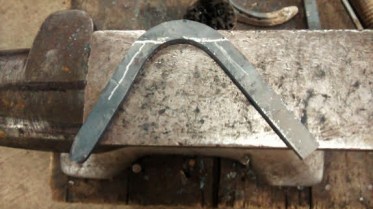
toe bend

Heat again. Turn branch. Mark nail holes.
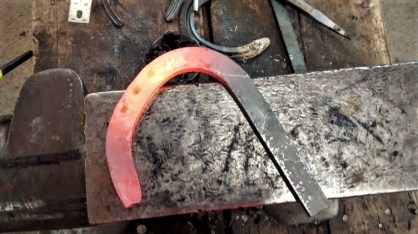
in process

Proudly show off finished product to instructor. Keep shoe forever.
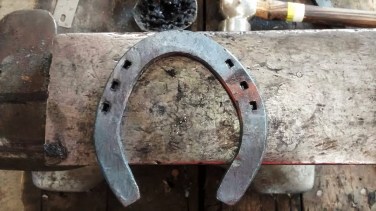
hand made shoe

 Changing topics…

This week’s field trip was to a pony barn.  I mean, a miniature horse barn. What’s the difference? Ponies have stocky bodies and are rotund.  They can come in various sizes. A mini horse has all the proportions of a regular sized horse, but they’re smaller (wouldn’t measure up to roller coaster height standards at Walt Disney World).  These particular mini horses, at the mini horse barn, were getting ready to travel to Oklahoma for a show. So we trimmed their mini hoofs.
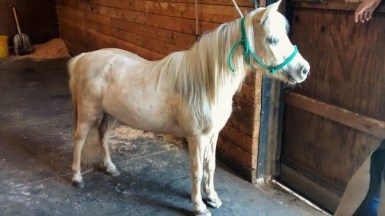
a little care

I’ve heard that some farriers don’t like working on mini hoofs. Practically speaking, it’s awkward to work so close to the ground, especially for the taller farriers. You’re also more like to rasp your hand, since you hold the hoof with your left hand and run your tools (big horse tools) with the other. Personally, I like them quite a bite, and I wouldn’t mind an entire clientele of minis. After all, I’m not that all.

Today, a dog came into the barn: a young lab, to be exact. He was a bundle of energy and happiness. He said hi to everyone, and could not stop wagging his tail. Horses are not as affectionate as dogs. In fact, I don’t even know how to tell if a horse likes me. Perhaps it has something to do with being a prey animal: you’ve got to choose your friends carefully.

Highlights of the week:  trimming the hoofs of a Freisian. Those are my favorite kinds of horses, even though they have big feet. Also, I think I might be improving. The teacher’s aid said to me today, “Hey, you’re doing what farriers do!”
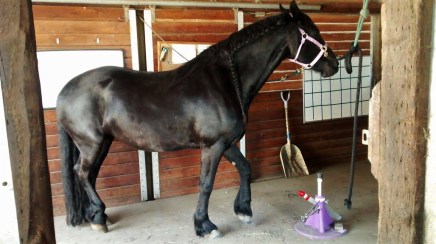
fresian trim

Another highlight: baby horse came in today. (They call those foals. You might have to practice pronouncing it as “fole” and not “foul.”) My classmate worked on getting this little guy used to trims / pedicures. He danced around her for about an hour, and then fell to the ground in exhaustion. Kinda like when you take a two year old to the grocery store. I wish all horses would just lie down like this for us.
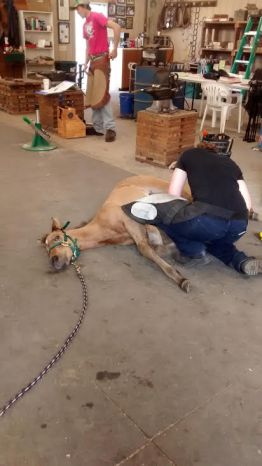
tuckered out

Much love from Snohomish County.

Love,

Angela
Angela at Farrier School, week 4

This weekend, my Mom told me about a story she read to her 5th graders that follows a fortunate/unfortunate plot line: “Fortunately, Stephen was invited to a birthday party! Unfortunately, the party was in Florida. Fortunately, someone loaned him an airplane! Unfortunately, the airplane crashed…etc.” I have felt this pattern in school, and I’m sure many of you can relate.
At this point in the program (end of week four) I am officially half way through this course. I’m really happy with how much I’ve learned in such a short time, and yet I don’t quite feel prepared to take on clients of my own. 


Examples of Angela’s progress:  

Fortunately, I can name all the bones and joints in the lower limbs of a horse. 
bones and joints

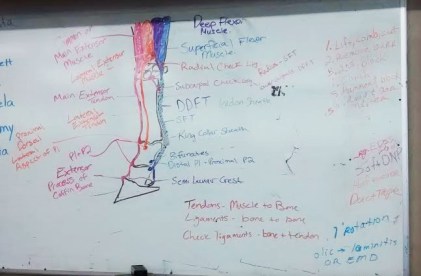
Unfortunately, they also have tendons and ligaments.

tendons


Fortunately, I can now make a decent crease in my shoes!

creased shoes

Unfortunately, Aluminum breaks when it’s too hot:

working with aluminum

Unfortunately, draft horses need shoes too!! (not my photo)
draft from cavalos mais blog.jpg

Fortunately, they make shoes in all sizes

draft shoes


It’s hard, dangerous, awkward work, but when I talk about it, I smile a lot. Does that mean I like it?  

Smiling,
Angela